Showing posts with label reform. Show all posts

Thursday, July 18, 2019

Police Reform—Part II: Training and Testing

Police in the United States killed over 1,000 people in 2016. More than any industrialized country in the world. The need for police reform has never been more needed than today.

Hit the Brakes! An allegory

A 16-year-old tugs at his dad’s sleeve and begs to be taught to drive the car. Dad believes it is time, so promptly shows his son how to start the car, put it in gear, hit the brakes, etc.  He even takes his son to a nearby parking lot and lets the youngster drive around the empty lot.  After they get back home, dad jumps out of the car and turns to his son.

“Okay, boy, you are ready to drive. Go take it for a spin.”

As you might expect, the son promptly goes out and gets into a horrific traffic accident. For although dad taught him how to physically drive the car, he didn’t teach such concepts as who has the right-of-way, how to merge into traffic, what the various traffic signs represent and more.

The boy knew how to drive a car, but he didn’t know how to drive with other people around him.

From teenage driver to armed police

This is the same scenario that plays out with police in the United States as it relates to guns. They are taught to use a gun, allowed some basic target practice and given a few rules to obey, then get handed a weapon and sent out into the world. They have no experience in having a gun while other people are wandering around them. They have no knowledge about when and when not to utilize said gun.

In fact, if anything, they are encouraged to turn to using the gun any time they encounter trouble.

• This is why we see cops shoot a man who has been pulled over for missing a front license plate .  


•When an unarmed teenager flashes his car lights at an officer 

• Or if someone who the policeman has asked to see his license reaches into his truck to get it.

Watch your temper

When you watch a football game, look at the referee on the sideline. He's being constantly yelled at by fans or coaches, some standing right beside him. Typically, he does not respond at all as he's trained not to react. That's what we need with today's police.

A large number of police in this country do not have the temperament to wield a gun. They are often ex-high school football jocks who got all sorts of respect while in school, but now are shocked and angry when they don't automatically get that same respect today while on the force.

This is why today we see a large number of unarmed people shot and killed by police:

• Father is dragging son away from cop who then shoots the unarmed young man.


• Policeman kills an unarmed teenager who is jumping on cars.


• Police officers shoot naked man wielding a stick.

The European Example
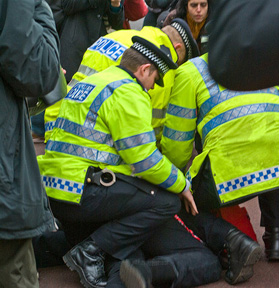

In contrast, in Europe the police typically disarm people without shooting or killing them:


• Four Swedish policemen vacationing in New York City break up a violent fight without harming anyone.

• German police use broom to disarm man wielding a sword.

In fact, the police in other western countries seldom fire their weapons at all and killing of civilians is almost unheard of in Europe. For example, in 24 years police in Wales and England killed 55 civilians, while in 24 DAYS in 2015 U.S. police killed 59 civilians.

The difference: Training

The reason for this disparity of outcomes is training and mentality.  

To become a police officer in any of the other western industrial nations (Europe, Canada, Australia, New Zealand) it requires from two to three years to get certified to join the force. For example, in the UK it takes a minimum of two years of training to become a police officer.  In Northern Ireland, the training requires those two years plus candidates must complete a 25 hour online course before that training even begins. In Norway, police must earn a degree from a three-year college before becoming officers.

Likewise, In Germany the training and education last three years, and it includes training in using a weapon—stressing NOT TO SHOOT.  A quote from this article explains this concept: “In every head of every policeman, there is the aim not to shoot,” says Col. Uwe Thieme, the four-star senior police director at the state’s office for education, training, and human resources.

Meanwhile in the U.S. the average amount of training is 15 weeks. Each city can be different, for example, Sacremento requires 23 weeks, while in North Carolina it’s 15 weeks. It actually requires more training to become a barber or hair dresser than to become a policeman in the U.S.  The training for cosmetologists ranges from 25 to 40 weeks.

Another difference: Attitude

Besides training, the other major factor for why police in the U.S. use their weapons more than other industrialized police forces, is due to mentality and attitude. By this I mean here in the U.S. police are trained to think that the best alternative in a dangerous situation is to use deadly force.

As mentioned above, police are given training in how to use a weapon and practice using it. Some get up to 60 hours of training like this. Often this training includes a computer simulation, a form of a gauntlet scenario. They must wander down a street filled with miscreants and a few innocent bystanders. The police must wisely shoot the bad guys but not the innocent civilians.

Yes, this training can help a person to learn to respond quickly to a situation. And admittedly, police are often in situations where they must make split-second decisions. However, this type of training also begins to plant a seed in the officers head that whenever he walks down the street, he’s in a battle zone. That just around the corner is some evil guy waiting to shoot him. 

As noted above, this is different overseas. Sure, they are taught how and when to use a weapon, but more importantly, their training stresses how to avoid that situation ever happening. They realize that once you get in your head that you must react a certain way in stressful situations (pull your gun, shoot the evil guy) you are likely to fall back on that instead of trying some alternative.

How to correct the problem

The United States must change how police officers are trained. As noted above, too often police departments rely on the easiest and cheapest way to train officers: they require less time for training.  The best way to have a more efficient and less violent police force is to implement this:

• Each state must have a standard for training of police officers to be licensed within the state. It cannot be left up to individual cities/counties. In other words, the training for a police officer in Austin would be the same as one in Dallas.
• Training would be for a minimum of two years at a state sanctioned academy. At least 1/4th of the training should be actual fieldwork. A large portion of this should include training to interact with the community—without the use of a weapon.

• Increase training in self-defense without use of a weapon.

• Increase training in how to diffuse a dangerous situation.

Step 2: Mandatory test to use a weapon

In the movie “Blade Runner” people were given the “Voight-Kampff test”  to see if they were human or android. In one scene, a person taking the test gets so angry at the question, he kills the man giving the test. Yes, he was an android. (for fun, take the test here to see if you are a replicant).

Although we don’t need to test people to see if they are human or not, we do need to test a person who wants to become a police officer to determine suitability for carrying a weapon. So besides improving training of police officers we need to ensure that the person we allow to join a police department isn’t a hothead who will use a weapon on someone else because his wife yelled at him before he left home that day.

The test would be some form of psychological evaluation to determine attitude as well as likelihood that a person might be unsuitable to carry a weapon.

Failing this test should not necessarily keep a person from joining the police force. It should only prevent the person from carrying a weapon. If the person passed the above academy but failed this test he/she could still be employed.

With this in mind, half of today's police force should be disarmed. Not just because they are not mentally stable enough to use it wisely, but also because the majority of encounters with civilians does not require a weapon. If the person wanted to carry a weapon, the person could be eligible for a retest after six months if he/she performed without incident in the field. Also, although current police officers should be "grandfathered in" so they don't need to go through the new training standards--they should be required to pass the psychological assessment in order to continue to carry a gun. If they don't pass they are not dismissed, just reassigned to a non-weapon division.

Conclusion

In many cases in which police shoot civilians, those police officers state that they "feared for their lives." Since a large percentage of those shot are unarmed, it means that police training is embedding in the recruit's minds that they will be constantly under attack; that they are going out into a war zone; every encounter could be dangerous. They are taught to be fearful. On the other hand, the training in other countries teaches recruits how to be prepared for dangerous situations, but also how to face common day-to-day encounters that are not dangerous and how to better interact with the civilian population.

What all of this boils down to is that police departments need to change the structure of how they carry out some of their duties. In Police Reform—Part 1 I talked about removing traffic duties from the police department and giving them to an unarmed city department. Part 3 of police reform will include suggestions on how a police department should be structured. For example, half of the department should be unarmed; there should be a rapid-deployment division that includes armed officers (not a SWAT team), etc. Current police forces have detectives, swat teams, police in uniform and other groups/divisions. Maybe there should be a different way to organize police forces.


Well, I had Part I, so it makes sense that sooner or later I'd include Part II.  This article originally was written as a HUB page.  However, they removed one of my other pages so to ensure this article is still floating around the internet, I thought I'd include it here at The Thurber Brigade. I'll get back to The War Between Men and Women (relationships) real soon. Really.


Wednesday, March 7, 2018

Police Reform—Part I

 
The days when you could stroll down your neighborhood street and smile and wave to that friendly Sheriff Andy Taylor have long passed. Society has changed much from those simpler times. However, although society has adjusted to a changing world, most police departments still cling to the beliefs, ideals and policies more appropriate for the 1950s.

The result of this lack of change in police culture (their weapons have changed) has resulted in a growing trend of violence toward average citizens. Because of better methods of recording events it may seem like this behavior is new, but it has been going on for some time. In the 1990s, I began work on a book about police violence and corruption, but abandoned the project when I couldn’t find a publisher. To read the article the research generated visit Dead Men Tell No Tales.

Therefore, the following is Part I of how to enhance our police departments and make them not only more efficient, but also make them a welcome part of the community rather than a feared enforcement army.
Traffic Tower-1920 (source: National Museum of American History)
Part I—Remove traffic enforcement from police departments

Imagine you are a young inspired person who wants to help protect society from those who might wish to do it harm. You go through a month-long (or longer) regimen of training and hit the streets as a newly minted crime fighter. The first evil villain to cross your path? An elderly woman with a burned out tail light.

That’s right, you must spend the bulk of your time enforcing rules about cars. We don’t send the police out to arrest a person who has a tree in their yard that is about to fall on a neighbor's house; we don’t send police to nab a butcher who sells moldy hamburger; we don’t call out a swat team to track down an owner of a business that has a gas leak that fouls the drinking water. We do send police to fine someone who has a problem with his/her car and send other city agencies for those other offenders.

Historically, police got handed traffic enforcement because cities either didn’t know who to give the responsibility to or didn’t want to spend the money to make a department that handled only that part of the law.

Did you know that although New York began registering some cars as early as 1901, it wasn’t until around 1935 that a majority of the states required driver’s licenses?  Often, you could get a license without taking a test. For example, in California they required a license beginning in 1913, but didn’t require a test for it until 1927. Connecticut enacted first speed limit in 1901, but many states didn’t have a limit until the 1930s. In other words, traffic enforcement didn't become standardized until later.

No one really knew for sure what to do with this new problem that cropped up: increased car traffic. So they gave the job to the people with nightsticks who really only wanted to go after murderers, bank robbers or other violent types.

The problem with police traffic stops is that people perceive them as threatening. For example, recent television ads in Texas show people freaking out when they notice the police in the rear view mirror.

Sure, it's upsetting to get a ticket since it costs money, but when that ticket comes from someone who is wearing a Gestopo-style black uniform and armed to the teeth, well, it makes the situation very tense.

So the way to improve this situation is to establish a city department that handles only traffic enforcement and allow police departments to handle real crime (Police Reform—Part II)

The name of this department could be anything from “Traffic Enforcement” to “Department of Transportation Control.” Anything except something with the word “police” in the title. The idea would be to strongly differentiate the two and to make this department as non-threatening as possible. Although enforcing the rules will result in a cost to the person who violates them, the attitude citizens should have toward the people doing this work should be similar to a meter reader who can cause your electric bill to go up.

Below are some points of consideration about this new department.

Ideas for the new Traffic Enforcement Department


• The uniforms should be non-threatening. No weapons; maybe polo shirts instead of starched, black button-downs; a color that stands out so it is easier for the public to find them in a crowd in case they are needed; equipment to carry includes an iPad or some handheld device to record violations and take pictures--but no weapons.

• They would log the violation into a database that would mail a notice to the violator. They could give a ticket to the actual person driving, but it’s only as a courtesy and only if it can be done in a non-threatening manner. The owner of the vehicle still gets a mail notice.
 Handheld device for tickets
• This brings up an important point too. The “ticket” is always assigned to the owner of the vehicle. In other words if Dad lets his favorite son drive the car to the prom, if the son runs a red light, Dad will have to pay for the violation. This will make reporting car thefts all the more important. If the traffic enforcer (TE) discovers the car has been reported stolen, then the TE calls the police to give the information. Because the ticket is given to the owner, the person does not need to present ID because the TE already knows the owner's name (it is called vehicle registration).

• No-chase policy for speeders. Ticket does not need to be given if the TE is worried about confrontation. If not given in person, the mail notice is still utilized. The violator would be logged in and a phone message would go to the speeder IMMEDIATELY warning them to stop as well as notice of violation. If driver is discovered still speeding at a further point (first contact would warn next TE further ahead) a second violation logged and the TE would go to the car owner's address and find out if there was a reason for this violation (needed to go to hospital, etc.). If not, the car will be “booted” until the traffic violation is paid. To help promote safety have a way for citizens to report speeders anonymously. This notice would alert a TE who would try to verify it (i.e. go to a spot ahead of speeder) and then log in violation. The payment for speeding violations is different than others (see below) as this violation may be a bigger threat to safety of other motorists. It should be noted that if police are chasing someone (bank robber, etc.) it should be reported so that the TE could assist in reporting locations (but not chasing).

• Traffic violations would be added on to the county tax bill for vehicle registration. In other words, the person doesn't have to pay right away, but can in order to keep future bill down.

• No warrant for nonpayment. Many cities have been resorting to a form of debtor's prison concept to get outstanding violations. This country was founded by people who wanted to get away from that odious concept, so we need to avoid it completely.

• The way around the above is this: when the tax bill is due, if the person involved can’t make any payment (there should be a way to have partial payments) the car is booted. If after a set time (two months, etc.) the car is impounded. After six months car is sold for payment. During this time the owner’s license is also suspended.

• Somehow, this bill should follow the person. i.e. if the person moves to another state that state will collect it. Maybe get a percentage.

• The only time police are called into action are cases where it is determined the driving might cause public harm. It should be a joint effort between TE and police to try and de-escalate situation. For example if they discover a drunk driver, car is booted until fine is paid, driver taken home, include mandatory AA-type class.

• Drivers may appeal a violation by going before a panel. The panel would be comprised of half city employees (traffic enforcement administrators, not TE who give out tickets) and half volunteer citizens. These citizens would have to meet certain standards such as be a city taxpayer, no outstanding tickets, etc.).

• Two biggest factors in all of this are that police are not involved and it needs to be a non-threatening service. This is a big change so there would need to be some form of transition plan, such as the police could ride along at beginning of this transition, sort of as backup, but would not approach vehicle.

• Too many cities see tickets as a revenue stream, but claim these tickets are all about public safety. Traffic enforcement needs to really be about safety and if city needs more revenue, they need to seek it other ways that are less threatening and punishing.

Summation


This part of Police Reform would be a major step and would not only change the structure of the department, but would also change the attitude and behavior of those involved. To many people—both police and civilians—traffic violations seem like a major offense. Because of this we see police pull speeders out of cars and beat them, we also see civilians attack police during a traffic stop. If we change the nature of traffic enforcement it would reduce and eventually eliminate these types of confrontations. Making this change would allow police to do the job they thought they were hired to do: fight real crime.

Part II will explore the next step in police reform, including whom we hire to police us as well as the way the police should function as a crime unit.
 Ahhh, James Thurber

This isn't a usual Thurber Brigade sidestep.  Although definitely not a relationship-related blog, this article is not included because of some big issue that loomed (ie another mass shooting).  This has been published because this article appeared as a HUB Page for years, but they decided it didn't have enough readers to keep active.  I thought it an important enough issue that it should still be floating around the internet.  Police Reform— PART II still shows up as a HUB page and I encourage you to read it as it's pretty controversial (disarm half the police? Yeah, it is).  Eventually, you may see it too at The Thurber Brigade.