UNARMED MAN SHOT BY POLICE.
Houston police officer K.N. Patton shot and killed James Cameron
Higgins with a single gunshot to the throat in March, 1990. Higgins was
unarmed and was driving a pickup that had one female passenger. Patton's
account states that he saw Higgins' truck pulling away from a
McDonald's restaurant where there had been a holdup and reports of
gunfire. Patton chased the truck, lights and siren on, but Higgins did
not stop until he had pulled into a parking lot and hit a utility pole.
With his gun drawn, Patton approached the truck and ordered Higgins out.
Higgins refused and Patton tried to force him out and in the process
the gun went off, the bullet striking Higgins. Drugs were found in the
truck, and the woman passenger was suffering from a drug overdose,
according to a statement by investigators. However, one eyewitness (not
the passenger) claims she saw the driver get out of the truck on his own
and then two police officers approached with guns drawn.Shortly
thereafter a single shot was heard. The suspect in the robbery that
brought Patton to the scene had fled on foot and was not apprehended,
and police suspect he took part in a convenience store robbery that
occurred a short time later.
Points to Ponder: Higgins was stopped, not because
he was suspected of having drugs, but because he was suspected of
robbery. The reason he was suspected of robbery: he drove by the
restaurant. Also, did Patton bother to ask why Higgins wouldn't get out
of the truck? Was it because Higgins was worried about the woman? If a
police officer really believes a man has a weapon, why get so close to
the person if he is not covered by his partner? If covered by his
partner, wouldn’t it be safer for all concerned to use two hands to pull
the man out, thereby making it easier to grab any weapon the suspect
might have? Source: Austin American-Statesman
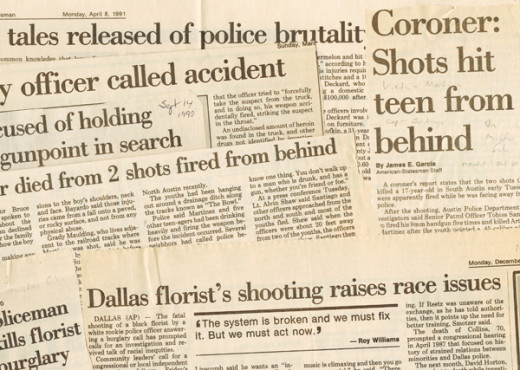
BLACK FLORIST SHOT BY WHITE POLICEMAN.
In Dallas on Dec. 4, 1990, a black florist who had rushed to his
business after he received a report about a robbery (the third in
slightly over a month), was shot and killed by Dallas police officer
Vincent Reetz. Reetz, just four months out of the police academy, shot
R.L. Rose once after ordering the florist to drop the gun he was
carrying. Rose had arrived on the scene before the police and was
hunting for the burglar while carrying his own gun. He identified
himself to Reetz' partner as the store's owner, but the rookie may not
have heard him. Reetz ordered Rose to drop his weapon, and when Rose
turned to face the young officer, thereby bringing his weapon around
toward the man, Reetz opened fire, striking the 53-year-old in the
chest. Reetz is the third Dallas police officer to kill a black person,
who had been armed in self-defense, within a three-year period.
Points to ponder: The usual question to ask in this
situation, which seems to be pretty prevalent across the U.S., is: if
Rose had been white, would the officer have fired? Another point to
ponder is that if Rose got to the site first, it means there was quite a
time lag between the call and the police arriving. Why wouldn't the
police think the owner would be there (and armed) and why would they
believe the robber would still be near the store? In the same vein,
sure, having a gun pointed at you might get you excited, but wouldn't a
burglar act differently than a shop owner (i.e. be crouched down hiding,
act frightened by approaching police, etc.) and shouldn't a trained
officer be able to tell the difference? Source: Austin American Statesman
OFFICERS SHOOT 81-YEAR-OLD.
Andres Acosta, an 81-year-old man who was hard of hearing, was killed
after being shot 10 times by two police officers who broke into his
Luling, Texas house late at night on a drug raid. The officers, Deputy
Al Alvarez of Hays County, and Deputy Mike Thompson of Blanco County,
had a warrant for the raid, but the address on the warrant was for a
different house. Police claim the house was correct, but the warrant had
a clerical error. The shooting took place on October 24, 1990, late at
night when the officers broke into the Acosta home searching for drugs
and to arrest Ruben Acosta, Sr., the son of the slain man. Andres Acosta
did have a gun and apparently fired at the officers, who were using
flashlights to see. Acosta had purchased the gun because he had been
robbed at gunpoint at his house two years earlier. Relatives claimed
that the man was partially deaf, sick and on medication. Ruben Acosta,
Sr., who may have been the target of the raid, was arrested on two
counts of aggravated assault from earlier incidents.
Points to ponder: This simply looks like a case
where an older man thought he was being robbed again, fired in
self-defense and was killed by police who had broken into his house.
Normally, this could just be chalked up to bad luck or misfortune, but
it really points to bad research on the part of the police. It should be
expected that a sudden, violent raid at night would be planned better,
say, finding out the possible inhabitants of the house, possible results
of a raid, past incidents at the house. In a case where there might be
innocent civilians present, different tactics beside macho strong-arm
assaults are called for. As for the man being shot, yes, he did fire at
the officers, perhaps in self-defense, but the point that stands out is
that he was hit 10 times by bullets (maybe more were fired). This
indicates somebody may have been edgy or trigger-happy, in other words,
perhaps the officers had a predisposition to use their weapons, no
matter what the incident that might evolve. Perhaps any movement may
have been enough to cause them to believe they were being threatened. Source: Austin American Statesman
TEENAGER SHOT IN BACK BY POLICE.
In Austin, Texas, a 17-year-old boy was shot and killed by a police
officer who had arrived in the area with other police to investigate
reports of gunfire. Arthur Martinez was killed by two bullets, one to
the head, one to the chest, fired by Senior Patrol Officer Tobias
Santiago. The incident occurred on Oct. 30, 1990, when police went to
investigate a group of about five youths who were thought to be drinking
alcohol and firing a pistol in a drainage ditch near some train tracks.
Supposedly, police approached the group and several of the boys ran
away. When the police were within 20 feet of the remaining boys, they
moved quickly to stop their escape. Santiago noticed then that Martinez
had a revolver and was pointing it at him, and so fired his own weapon.
Santiago claimed to have been shouting to the youths that he was a
police officer during the course of the incident. The coroner's report
stated that the bullets entered the body from behind and from around 3
feet or more away.
Points to ponder: The most obvious point is, of
course, the difference between the officer saying the boy was facing
him, and the coroner's report that the youth was shot from behind. To
most observers, this would seem to indicate the boy was running away,
albeit possibly with a gun in his hands. Also, somehow the police were
able to get very close to these boys, yet none felt threatened until one
officer was within extremely close range. If one of the boys did have a
gun (in the report it wasn't in the slain youth's possession) wouldn’t
he have fired or pointed the weapon earlier, and not waited until an
officer was within reach? Another strange point is: why did the police
approach in this manner if they knew the boys had been drinking and
shooting a weapon? Was a confrontation desired? Source: Austin American Statesman
MAN SUFFOCATED IN POLICE HOLDING CELL.
Dane Kemp, 28, arrested on assault charges for allegedly
pistol-whipping his ex-girlfriend, was suffocated by five police
officers from Brooklyn who were trying to subdue the man. A medical
examiner stated that he was asphyxiated due to compression of his chest
and neck while he was being restrained for violent, agitated behavior.
The statement also said Kemp had crack and alcohol in his blood but not
enough to cause death. Kemp was arrested early in the morning of Jan. 1,
1990, and the police handcuffed one of his arms to a bar of the holding
cell. He suddenly became enraged when his former girlfriend walked by,
and began yelling that he was going to kill her and also began banging a
chair with his free hand. Five policemen entered the cell, strapped his
legs with a Velcro strap, released his handcuffs, then bound his hands
behind his back with another Velcro strip. The police did not report
sitting or kneeling on his neck or chest in their report. The officers
then carried Kemp out of the cell and strapped him to a gurney that was
brought from an ambulance parked at the building. Two minutes later, the
ambulance crew reported his heart had stopped beating. Police maintain
he stopped breathing outside the precinct, his girlfriend stated that
when he was wheeled past her on the way to the ambulance, he appeared
dead. The officers involved were: Sgt. Thomas Urban, Officer Robert
Schievenbeck, Timothy Wolf, Joseph Zogbi, and Anthony Kianka.
Points to ponder: With overwhelming odds such as
this, it seems strange that it would require sitting on the victim's
neck and chest to subdue him, even though he was very agitated. If they
had released his hand before attaching the strip around his legs, it
might be understood that more force was needed to subdue the man.
However, they strapped his legs before releasing his other hand, which
meant that if standing he would be off balance, and if on the floor,
unlikely capable of putting up much of a fight with five men. Source: New York Times
UNARMED 17-YEAR-OLD KILLED BY POLICEWOMAN.
A 17-year-old, unarmed man was shot and killed in Bedford-Stuyvesant
in New York, by a policewoman who was holding him at gunpoint. On
January 27, 1990, Louis Liranso had been involved in an argument with a
neighbor when police were called to break up the fight that witnesses
claimed involved shouting and wrestling. Liranso had chased another
25-year-old man into a building where he was apprehended by two other
police officers, who in turn took him outside and handed him over to
Officer Hyda Hernandez. Two stories develop from here. Police state that
she guarded him as he stood beside the wall of a Chinese restaurant,
when he suddenly dropped his hands and turned toward Hernandez, who shot
him once in the back (?). Witnesses say Hernandez was taking him into
the Chinese restaurant when he tripped and then the officer shot him.
Witnesses also say that the teenager had been drinking. In later
testimony at the grand jury hearing, Hernandez claimed that the boy had
grabbed her arm and tried to take the gun away from her. She made no
statement prior to her Feb. 13 hearing.
Points to ponder: Shot in the back while struggling
for the weapon? Was he reaching behind himself for the gun? Why delay
making a statement, and more importantly, why did Hernandez make a
different statement at the hearing than what was originally in the
police report? Source: New York Times
UNARMED 14-YEAR-OLD KILLED BY POLICE.
An unarmed 14-year-old boy, allegedly fleeing from a $10 robbery, was
shot and killed January 31, 1990 by a Brooklyn police officer, in the
Bushwick section. According to police, Jose Luis Lebron was running
toward Officer Frank Albergo when the boy reached into his jacket and
pulled on a zipper. The officer thought he was reaching for a gun and
shot him in the head. The police stated that the incident began when a
man who was robbed of $10 flagged down police. Together the men cruised
the neighborhood looking for the two youths who had committed the
offense. The men spotted the two teenagers (the other boy was 19) and
Albergo jumped out of the car and grabbed the older of the two. His
partner chased the other suspect, who stopped, turned and ran back
toward Albergo, who was still holding the first suspect. Albergo ordered
the young boy to stop, and when he didn't, Albergo shot him. Witnesses
claimed the boy did reach into his jacket, but pulled his hand out
slowly, not suddenly, and not threateningly. They also claim he was shot
twice. The lawyer who represented the family in the case claimed that
the boy was running away from the officer when he was shot, not toward
him. The coroner's report showed the bullet entered the back of the head
behind the right ear, traveled diagonally, then lodged on the outside
of the left eye socket. Another oddity, was that police claim the boy
was shot from six to eight feet away, while the police photo showed that
it was more like 25 feet. Police did not have an answer about how the
boy was shot in the back of the head while running toward the officer.
Points to ponder: Of course, the conflicting
evidence is the major point to consider, but a side note is that nowhere
in any of the articles about the case was it mentioned that the two
teenagers used a weapon, especially a gun, while committing the alleged
robbery. Therefore, why was a gun needed by the police to stop the teen?
And more importantly, if the shooting took place from eight feet away,
even though it was 5:30 in the evening, why couldn't the police officer
tell if the youth had a gun in his hand? (Cynical aside: Are NY police
required to take an eye exam?) Source: New York Times
ARMED 13-YEAR-OLD KILLED BY POLICE.
A New York policeman shot a 13-year-old boy, who was carrying a gun
and chasing another teenager who also had a gun, on February 2, 1990.
Both boys were suspected of holding up a truck driver. The story: Robert
Cole and two other teenagers tried to hold up a truck driver, who
resisted and even took away the gun Cole was holding. The boys ran away,
but the truck driver saw Cole returning shortly thereafter and he was
now carrying another gun. The driver flagged down a nearby EMS ambulance
to seek assistance. The EMS and truck driver drove a short distance and
stopped a police car with two officers. Both police officers got out of
their car and confronted Cole. Officer Larry Walton ordered Cole to
stop and drop the weapon. Cole refused and pointed the weapon at the
police officer. Walton quickly shot Cole in the chest and the youth died
shortly thereafter.
Points to ponder: This was slipped in to show that
admittedly, it isn't easy to be a cop. Some situations are not only
dangerous, but also very confusing--and in the end, tragic. Sometimes,
violence has to be used, as it seems in the case above. But the
important thing for people, especially police, to remember, is that this
shouldn't be considered the norm. Neither police violence, nor children
with guns should be considered acceptable or normal. Source: New York Times
POLICE KILL MAN THREATENING SUICIDE.
Brooklyn police shot and killed a 20-year-old man who was holding two
knives, threatening to kill himself. On March 1, 1990, David Cotto was
shot nine times by police who say they fired when Cotto charged at them
after he was maced by one of the officers. Another family member called
police to Cotto’s family apartment after Cotto became involved in an
argument with an upstairs neighbor. When the police arrived, they found
Cotto holding two kitchen knives. At this time, he held one to his
throat and threatened to kill himself. The police somehow calmed him
down and convinced him to drop the knives. Cotto did this, but then
rushed to the kitchen and grabbed two more knives. The officers ordered
him to drop these also, and when he didn't Sgt. Vincent Guzzo sprayed
mace into his eyes. The police report of the incident states that Cotto
then lunged at the officers and Officers Joseph Galli and Patrick
Balsamo fired their weapons. A total of 11 shots were fired. However,
Cotto's sister and father, who were in the apartment, claimed that the
man never lunged at the police, but instead dropped the knives and
brought his hands up to rub his eyes. It was at that time that the
police opened fire. They also stated that at one point Cotto yelled he'd
kill himself before he'd let a cop kill him.
Points to ponder: Admittedly, the man was acting
irrational, but the actions of the police sound equally odd. There was a
minimum of three officers present, the man had mace in his eyes, and
yet, the only way to stop him was to shoot him? For the most part, the
mace incapacitated the man. Couldn't a nightstick be used? How about
getting a family member to talk to him? Of course, the big question has
to be: Eleven shots? Did the police believe the man had his knife set on
semi-automatic? Source: New York Times
OFF-DUTY OFFICER KILLS 62-YEAR-OLD.
In Brooklyn, a 62-year-old man leaned on his horn a little too hard
and ended up dead by the hands of an off-duty police officer. "It's so
ironic," a neighbor would say later, "For a person who was always
working very, very hard to stay within the law to get shot--and by the
law." On January 23, 1989, Stephen Kelley stopped his pickup behind a
car that was parked and blocking the service drive to Kelley's apartment
complex. Radames Ortiz, the off-duty policeman, was a passenger in the
car driven by his sister, who also happened to be an off-duty officer.
Neither was in uniform. Kelley honked his horn at the parked car and
Ortiz jumped out of the car and walked to Kelley's truck. Ortiz did
identify himself as a policeman, but an argument developed anyway. Ortiz
sister got out of the car and joined the argument. Shortly after this,
Ortiz pulled a pistol and a struggle developed for the weapon. Kelley,
who was unarmed, was shot twice in the stomach. No other weapon besides
Ortiz' was found at the scene, and the officer refused to give a
statement about what happened to officers who arrived to investigate.
Points to ponder: A case of power corrupting? The
officer was off-duty, out of uniform and apparently parked illegally.
Did he perhaps believe that as a police officer it was okay to do this
and that no one had a right to question what he did? If this was not the
case, why did he feel it was necessary to identify himself as a
policeman? After he identified himself as an officer, did he become even
more incensed that a mere civilian would still argue with him for
blocking the drive? So incensed, that he pulled his weapon? Or did he
really feel physically threatened by a 62-year-old man who just wanted
to get to his apartment's parking lot? Source: New York Times
22-YEAR OLD DIES AFTER STRUGGLE WITH POLICE.
Officers Kevin Muholland and Mark Meehan of the Morristown, N.J.
police department were patrolling near a local tavern on January 29,
1989, when they noticed John Jackson, 22, passing by. They remembered
that Jackson had a warrant out for his arrest, so the men chased him
toward his apartment. A third officer walking around a corner of the
building ran into Jackson, knocking him down. According to police, they
then handcuffed Jackson, who continued to struggle with them, but as
they were putting him in a police car he went limp. A sergeant on the
scene told the officer to take Jackson to the hospital, as he had
reported earlier that he was an asthmatic. While in transit, police
stated that they discovered he was unconscious. Jackson was pronounced
dead at the hospital. Witnesses to the incident claim the police had
Jackson in a chokehold and repeatedly banged the man's head on the
patrol car. They also stated that he was unconscious before being placed
in the patrol car. The medical examiner stated that Jackson died of
cardiac arrhythmia, brought on by cocaine use. Cocaine, morphine and
traces of other drugs were found in his blood. He also reported that he
couldn't find any evidence of brutality, but also reported the dead man
had a cut above the right eye and bruises on the scalp. Police claimed
those wounds were the result of the fall Jackson took when he ran into
the other police officer.
Points to ponder: Although most of the details in
the reports were sketchy, it seems that there were a minimum of four
police in contact with Jackson when he was arrested. There was no
mention of him being armed, and it was a case of white officers in a
black neighborhood. If he did die of cardiac problems, is it possible
the force the officers used compounded them? Was he struggling because
he couldn't breathe? Again, here is another case where the police have
far superior numbers, but are still using over-zealous force to subdue a
possible suspect. One versus one, or maybe two vs. one and it's
possible that strong force may be needed. But four versus one? Source: New York Times
MAN DIES 90 MINUTES AFTER ARREST.
Richard Luke, 25 and an asthmatic, ran into his apartment in Queens,
N.Y. on May 21, 1989, and in a frantic state claimed he was having
problems breathing. Perhaps in fear, he ran out of the apartment, and
his sister called for an ambulance. As a matter of routine, the EMS
called the housing police to assist. Just as routine, two stories
developed. Officers Alfred Cavanaugh and Michael Segarra claim that Luke
assaulted them in a completely unprovoked attack. They chased him back
into the apartment building, handcuffed him and took him to a holding
cell in a housing police station. While Luke was in that cell, he became
enraged and began beating his head on the cell floor. Police subdued
him again and took him to a hospital, where he died. They claim that two
vials of crack fell out of his pocket while he was in their custody.
Witnesses to the incident, including his mother, claim a slightly
different story. His mother stated that she saw him being chased back
into the apartment building by police. When she ran down to the lobby,
she found police were struggling with Luke on the floor. Other witnesses
claim that one of the officers involved in the lobby struggle had a
nightstick to Luke's throat, choking him. Six other officers came to
assist during the struggle. Luke's mother screamed at the officers to
stop, but they said that he was resisting arrest. However, she claimed
he looked too sick to resist. The woman followed the police to the
station, and while there could hear her son screaming. When she
frantically asked police what was going on, they told her Luke had gone
crazy and was beating his head on the floor. Later, the medical examiner
claimed Luke died from "acute cocaine intoxication." The autopsy showed
scrapes to Luke's skin and bruises to his head, trunk, lower and upper
extremities. Asthma was not considered a factor in the death. Friends of
Luke claim he didn't use cocaine.
Points to ponder: If we really wanted to act
paranoid, we'd say it was suspicious and the police were planting
evidence to calm down a racial incident. Yes, again it was white police
in a black section of a town. But in this case, it looks like the
typical habit of too much force compounding a bad situation. The man was
acting frantic because he probably thought he was dying (without police
help), because of his breathing problems. The police took his actions
as threatening and reacted violently, even though the odds were, once
again, extremely in their favor. Apparently, at one time even reaching
eight to one! Using excessive force on a man having trouble breathing
may not cause death, but it does add a contributing factor. Source: New York Times
OFFICER KILLS FOR THIRD TIME IN SIX MONTHS.
Arlington, Texas detective Brian Farrell can now add a third notch to
his pistol after shooting a forgery suspect who was holding a round-tip
dinner knife. It was the third person killed by the officer in a
six-month span. Farrell was suspended from the force shortly after this
last incident, largely because investigators found two notches carved in
the grip of his gun--much like the ones gunslingers from the old west
carved into their pistols to note the number of victims of their quick
draw. This third incident occurred on February 1, 1989, when Farrell and
his partner went to Dallas to arrest Michael Robinson on a felony
warrant for forgery. When Robinson didn't answer the door, the officers
kicked it in and entered the house. They found the man hiding behind a
counter, and when the two plainclothes detectives confronted him, he
held up a round-tipped dinner knife to fend off their advance. The two
officers began to back out of the house, talking to the man as he
followed them out. Several times they ordered him to drop the knife, but
he refused, and according to the officers' report, he stated they'd
have to kill him before he'd drop it. When the group finally stopped
outside, a short shouting match ensued, with the police repeating that
Robinson should drop the knife. According to the first report, the men
were only about three feet apart during this shouting match. When
Robinson again refused to drop the knife, Farrell shot him. The report
said Robinson did not lunge at the officers with the knife, however, in a
later account, the police said he did. Robinson died a short time later
at an area hospital. A few other interesting points about this case
include that it is against Arlington police procedure not to notify
Dallas police that they are operating in their area. Also, the procedure
for the Dallas police is for them to hold the suspect at bay and call a
tactical unit to handle the situation. Another interesting note is that
when Dallas police did arrive on the scene, Farrell demanded a lawyer
before he would release a statement (to the police). Not only that, but
Farrell had been assigned to forgery duty because of the earlier
shootings, and the Arlington police were hoping to keep him away from
incidents where there might be such confrontations. This was the first
forgery suspect killed by Arlington police in 10 years. And for those
who like to compare kill ratios: No Arlington police officer has been
killed since 1975.
Points to ponder: There are just too many. But one
thing to mention is, that this case is why the outcome is not mentioned
in any of the others. Farrell was absolved of blame for this killing,
just as he had been for the two others he had committed. He was only
suspended for suspect behavior and for not following procedures. All of
the incidents he was involved in sound suspicious, although this author
won't say he is guilty of anything, this is a perfect example of the
police word vs. civilian's word. The police are always believed and the
evidence has to be overwhelming to get any sort of conviction. Robinson
is dead, and although all he did was hold up a dull dinner knife toward
two officers, we will never get to hear his testimony as to what
happened. So it is the police word vs. the police report. How just. Source: Dallas Morning News